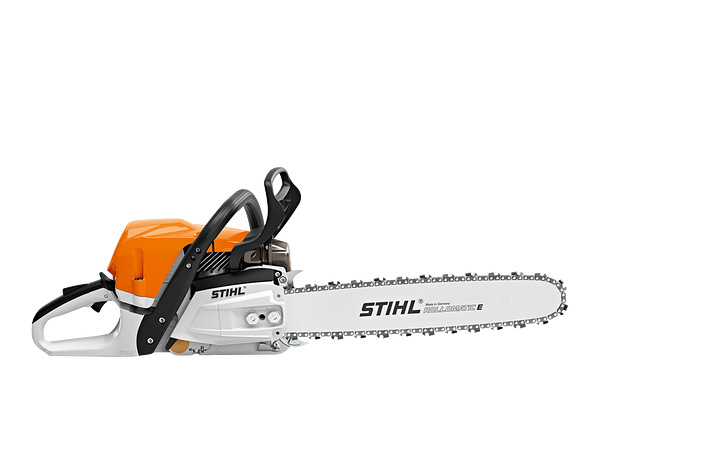
Professional here means a saw built to run most days rather than a few weekends a year. The difference is construction and serviceability rather than raw cutting speed, and it only pays back in hours of use.
We have 17 saws tagged for this job, 15 of them current. The short answer:
- Felling and cross-cutting: 50 cc upwards with a 45 to 50 cm bar.
- Climbing work: a top-handle saw, for trained and roped operators only.
- Milling and big timber: 60 cc upwards, often with a wrap handle.
- Battery on site: the professional-platform saws from Stihl and Husqvarna, which run on their own high-output packs.
Saws for professional and daily use
Current models tagged for this job, shortest bar first.
What the grade buys
Magnesium crankcases rather than plastic, better anti-vibration mounts, multi-stage air filtration that survives a dusty day, decompression valves, and a design meant to be stripped and rebuilt rather than replaced when something wears.
Electronic engine management, Stihl’s M-Tronic and Husqvarna’s AutoTune, belongs mostly at this level. It keeps the carburettor correct for altitude, fuel and a dirtying air filter, which matters when the saw runs all day in changing conditions.
Vibration is the occupational issue
Hand-arm vibration syndrome is a real and permanent injury, and it is the reason professional saws spend money on isolation mounts. Anyone using a saw daily should be tracking exposure time, not just wearing gloves.
This is also an argument for battery saws in professional use: they vibrate less, and for arborists doing repeated short cuts the exposure difference over a career is substantial.
Training, certification and insurance
Using a chainsaw at work, or for payment, requires recognised training and certification in the UK, and the duty sits with the employer. Felling, climbing and windblow each need their own units; a ground-use ticket does not cover tree work.
Insurers ask for proof after an incident, and public liability cover for tree work is normally conditional on it. Whatever the paperwork says, the training is what keeps the statistics on your side.
Is it worth it for home use
Usually not. A professional saw cuts the same log as a good mid-range one, weighs more and costs several times as much. The durability only pays back in hours.
If you are cutting most weeks, felling regularly or running a saw commercially, it repays quickly in lower vibration, better filtration and a machine a dealer can actually service rather than scrap.
Browse another way
By power source: petrol, cordless or corded. By cutting length: 12 inch, 14 inch, 16 inch or 18 inch.
Professional Chainsaws FAQs
What makes a chainsaw professional grade?
Construction and serviceability: magnesium crankcases, better anti-vibration mounts, multi-stage filtration, decompression valves and a design built to be rebuilt. Electronic engine management such as M-Tronic or AutoTune usually appears at this level too. It is about surviving hours of use rather than cutting faster.
Do you need a licence to use a chainsaw professionally in the UK?
Not a licence as such, but recognised training and certification are required for any chainsaw work carried out at work or for payment, and the legal duty sits with the employer. Different units cover ground cutting, felling, climbing and windblow. Insurers will ask for proof of the right one.
Are battery saws used professionally?
Increasingly, yes, particularly in arboriculture and in noise-sensitive locations. The professional battery platforms from Stihl and Husqvarna produce enough output for climbing saws and mid-size ground saws, vibrate less and start instantly. Petrol still dominates sustained felling and remote work.
Is a professional chainsaw worth it for home use?
Rarely. It cuts the same logs as a mid-range saw, costs several times more and weighs more in the hand. Unless the saw is working most weeks, the money is better spent on a good mid-range machine, a spare chain and proper protective kit.